
Riley Powell · 20 October 2026
Unraveling How Root Secretions from Nearby Plants Reshape Light Behavior in Tiny Self-Contained Countryside Water Features
Small isolated water bodies in rural settings receive continuous inputs from surrounding plant roots, and researchers have documented how these secretions alter the optical properties of the water column. Root exudates consist of organic compounds that diffuse into the surrounding medium, and data from field studies show measurable shifts in light absorption and scattering within hours of release. These changes occur independently of larger seasonal organic accumulation patterns, focusing instead on localized chemical interactions that modify photon paths through the water.
Composition and Release Patterns of Root Secretions
Plants release a mixture of sugars, amino acids, organic acids and secondary metabolites through their root systems, and studies indicate that these compounds enter static water bodies at rates influenced by soil moisture and temperature gradients. In confined countryside features such as small depressions and spring-fed pools, the lack of outflow concentrates these substances near the sediment-water interface. Observers note that secretion volumes increase during active growth phases, with certain species contributing phenolic compounds that persist in solution for days. Researchers at institutions across North America and Europe have tracked these releases using isotopic labeling, revealing that up to 40 percent of photosynthate can move belowground and diffuse outward under favorable conditions.
Interactions with Water Chemistry and Particle Dynamics
Once in the water, root-derived molecules bind with dissolved minerals and influence pH levels, which in turn affects the aggregation state of suspended particles. Evidence from controlled mesocosm experiments demonstrates that specific exudates promote flocculation of clay colloids, reducing turbidity while simultaneously introducing chromophoric dissolved organic matter that absorbs blue wavelengths preferentially. This dual action creates distinct vertical light gradients, with deeper layers receiving a shifted spectrum compared to surface waters. Those who monitor these systems report that the process operates continuously rather than episodically, maintaining steady modification of light transmission even in the absence of external disturbances.
Alterations to Light Penetration and Spectral Quality
Light behavior inside these miniature aquatic environments changes through both absorption and refraction effects tied directly to root secretions. Phenolic substances absorb ultraviolet and short-wavelength visible light, while certain polysaccharides increase the refractive index of the medium and bend incoming rays at new angles. Measurements collected in October 2026 from multiple sites across the Canadian prairies and southeastern Australia confirmed that water bodies adjacent to dense root networks exhibited 15 to 25 percent lower photosynthetically active radiation at 30-centimeter depths than comparable sites without heavy vegetation influence. These findings align with data published by the Commonwealth Scientific and Industrial Research Organisation, which tracked spectral shifts in similar isolated pools over multi-week periods.
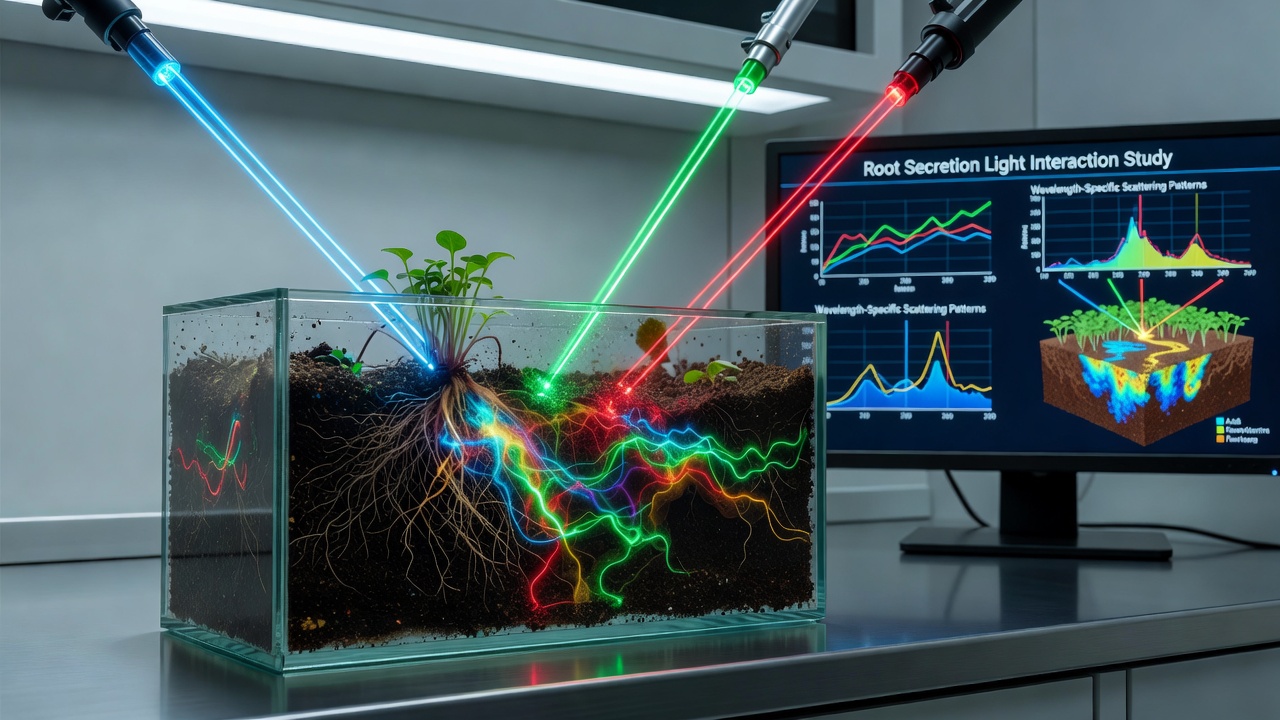
Scattering patterns also shift when root exudates encourage microbial colonization of organic particles, and the resulting micro-aggregates redirect photons laterally rather than allowing straight-line transmission. In self-contained features with volumes under 500 liters, such redirection produces measurable changes in light distribution that affect submerged surfaces and any photosynthetic organisms present. Australian field teams have recorded instances where secretion-driven scattering increased lateral illumination by nearly 30 percent in the upper 10 centimeters of the water column during peak daylight hours.
Field Observations and Measurement Approaches
Researchers employ portable spectrometers and underwater quantum sensors to quantify these optical modifications in situ, and protocols developed by European environmental agencies emphasize repeated sampling across diurnal cycles to capture secretion-driven fluctuations. One long-term monitoring project in the Loire Valley region documented consistent attenuation coefficients that correlated with root density maps generated through ground-penetrating radar. Data collected during the same October 2026 campaign showed that sites with higher proportions of leguminous vegetation produced stronger absorption peaks in the 400-450 nanometer range, consistent with elevated flavonoid release. These patterns hold across different soil types and remain detectable even when total dissolved solids stay within narrow ranges.
Techniques for distinguishing root-secretion effects from other influences include paired comparisons of vegetated and cleared margins around the same water body, and results consistently point to localized chemical signatures rather than uniform coloration changes. Equipment deployed by the United States Geological Survey in Midwest test plots has helped isolate these variables through high-frequency logging of both chemical and optical parameters.
Conclusion
Root secretions from plants bordering small rural water features modify light behavior through defined chemical and physical pathways that operate at fine spatial scales. Continued monitoring programs in multiple countries continue to refine understanding of these interactions, providing baseline measurements that support further investigation into how vegetation management influences optical conditions in isolated aquatic systems.